Before They Fight for the Crown, They'll Fight for Their Countries: Gukesh and Sindarov Head to the Chess Olympiad
The team lists for the 2026 Chess Olympiad in Samarkand are out, and buried in the numbers is a delicious subplot: World Champion Gukesh and his challenger Sindarov could lead their countries against each other months before their real title fight begins.
- chess olympiad
- fide
- gukesh
- sindarov
- uzbekistan
- india
- samarkand
- world championship
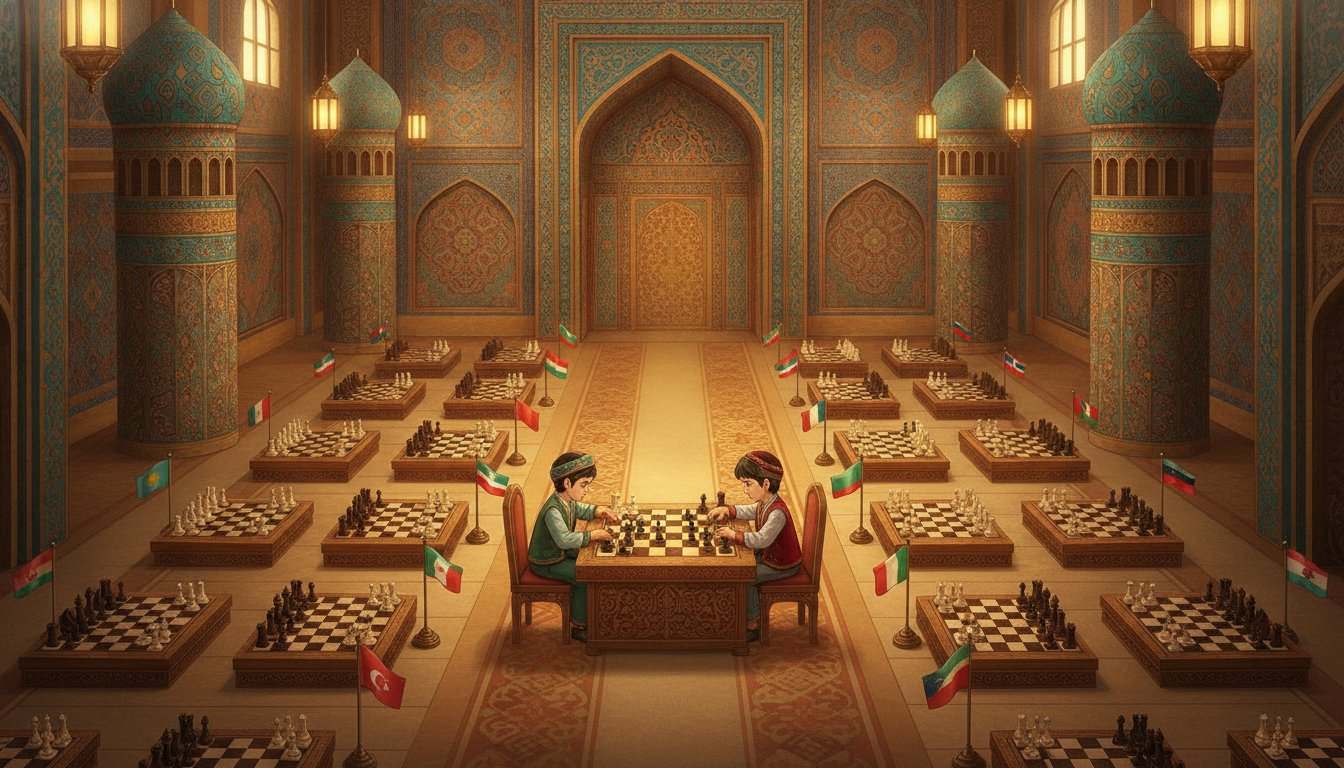
Imagine two boxers who are scheduled to fight for the world title in December. Now imagine that two months earlier, they both show up at a giant team tournament — not against each other, but each one leading their own country's squad into battle.
That's basically what's about to happen in chess.
The full team lists for the 2026 FIDE Chess Olympiad were just released, and while most of the headlines are about missing superstars, the quietest detail might be the best one: World Champion Gukesh Dommaraju and his title challenger Javokhir Sindarov are both about to lead their national teams into the same event — one last meeting before they sit down for real in Geneva this winter.
What Even Is the Olympiad?
If you're new to chess, think of the Olympiad as the World Cup of chess — except almost every country on Earth sends a team. It happens every two years, and this time it's landing in Samarkand, Uzbekistan, from September 16 to 27.
The lineups for 2026 have just been released and show 208 teams registered for the Open section, an increase of 13 compared to 2024. In the Women's section, there are 192 teams, making a total of 400 teams—20 more than in Budapest. That's roughly two thousand players from around the world, all playing chess in the same building for two weeks straight.
The Big Names Who Won't Be There
Every huge tournament has its ghosts — the players everyone expected to see, who simply aren't coming. This year there are three.
The biggest is world number-one GM Magnus Carlsen, who is absent from the Norwegian team. Without him, a team that would be a medal contender after finishing fifth in 2016 is barely inside the top 20 seeds.
Then there's Alireza Firouzja, who is not competing for France, which he hasn't done since 2021. This time, though, the French federation didn't just shrug it off — the federation said the 23-year-old declined to play "without officially stating his reasons," and said he would not be included again for France unless he demonstrated a lasting commitment to the national team. That's a rare, pointed public statement for a chess federation to make about one of its own stars.
And Hikaru Nakamura, still the world's third-best player, is skipping it again too. On his stream, the 38-year-old expressed that he was unhappy with the financial conditions, but also added that he wants to give younger players an opportunity to play — pointing out that Olympiad pay hasn't changed in a decade.
The Real Story: A World Championship Preview
Here's where it gets interesting for anyone who's been following Gukesh and Sindarov's rivalry this year.
India and Uzbekistan are seeded second and third, respectively, creating the possibility of an Olympiad encounter between the national teams of the next two world championship contenders. Gukesh will defend his title against GM Javokhir Sindarov in Geneva, Switzerland from November 25 to December 15, less than two months after the Olympiad ends, so this is likely the last time they meet in person before the match. At just 20 years old each, they will contest the youngest world championship match in history.
Sindarov arrives with serious pedigree — he was a part of the Uzbek team that sensationally won Olympiad gold in 2022, and followed it with bronze in 2024, and he's now Uzbekistan's top-rated player. Gukesh, meanwhile, is trying to shake off a rough year. Back in Budapest 2024, he won the individual gold medal on board one by scoring a stunning 9/10 and a 3056 rating performance to almost hit 2800. Since then, though, he's had a dreadful run of bad performances to drop almost 100 points to 2703 and 31st in the world.
Whether or not their boards actually cross paths in an India-Uzbekistan match, both men will be walking into the same building, under the same pressure, with the same December deadline hanging over them. It's the closest thing chess fans will get to a preview trailer.
India Is Still the Team to Beat
Even with Gukesh out of form, India isn't panicking. They've kept nearly the whole squad that dominated Budapest, with Nihal Sarin replacing 40-year-old Pentala Harikrishna, leaving the average age of the team below 24.
That's a lineup built to repeat history. It would not be a sensation if India wins another gold medal with that powerhouse lineup, and would make India the first team since Armenia, which won in both 2006 and 2008, to successfully defend the Open Olympiad title. But their 2024 run was almost flawless — India won 10 matches and drew just one in Budapest, a near-flawless performance that felt almost untouchable—and one that will be extraordinarily difficult to reproduce.
The U.S. remains the top seed on paper, even without Nakamura — thanks to Fabiano Caruana, Wesley So, and newcomers Hans Niemann and Awonder Liang. But the gap is thin: their average rating of 2751 puts them 18 points ahead of defending champion India. Uzbekistan is next, 13 points behind, while China trails the Americans by 45 points, making these the only teams with an average rating above 2700.
Kids Who Could Be Your Grandchildren, and Legends Who Remember Rotary Phones
One of the sweetest things about the Olympiad is that it throws every generation onto the same stage.
On the young end, 12-year-old GM-elect Faustino Oro will make his debut for Argentina. The world's second youngest grandmaster of all time will see his title finally confirmed during the Olympiad. Turkiye's 15-year-old Yagiz Kaan Erdogmus is already the nation's highest-rated player by far... up to 2716 and world number-27, overtaking Gukesh as the world's highest-rated junior. And in the Women's section, 11-year-old FM Bodhana Sivanandan returns after becoming the youngest to ever feature for England in an Olympiad at nine.
On the other end of the spectrum, chess's living legends keep showing up too. Watch for veterans like Vasyl Ivanchuk, Peter Leko, and Alexei Shirov back at the board — and in the women's event, don't miss 63-year-old GM Pia Cramling, who plays her 15th Chess Olympiad! Fifteen. That's not a typo — that's a chess life well lived.
The Women's Race Has Its Own Twist
China has the four highest-rated women in the world, but only one of them is showing up. The four highest-rated women in the world are all from China, but only their fourth-ranked player GM Zhu Jiner is featuring for their Olympiad team. That means Women's World Champion Ju Wenjun and former champion Tan Zhongyi are both sitting this one out.
India, on the other hand, is going in as the clear favorite, with veteran Koneru Humpy returning to a squad that's arguably even scarier than the one that won gold in Budapest.
One Federation Returns, One Stays Locked Out
There's a bit of politics folded into the team lists too. Belarus will compete under its national flag after FIDE last month lifted the restrictions that had required Belarusian players and teams to use neutral symbols. Russia, meanwhile, is still out — no Russian team will take part in Samarkand as the Chess Federation of Russia (CFR) was suspended after refusing to follow a verdict by the Court of Arbitration for Sport (CAS) related to organizing chess activities in occupied Ukrainian territory.
Why This Matters
Six weeks from now, close to two thousand players — pre-teens, pensioners, world champions, and everyone in between — will fill a hall in Samarkand and play chess for their countries. Somewhere in that crowd, two 20-year-olds who are about to fight for the biggest title in the game will be sitting a few boards apart, each one carrying his country's flag instead of just his own name.
Geneva is where their story gets decided. Samarkand is where it gets its final warm-up.
PrimeChess Courses
Keep learning with PrimeChess
Stuck at chess and not seeing progress? The Beginner Course helps players build reliable tactics, opening habits, and endgame confidence so rating plateaus become easier to break.