Why Chess Kids Have Sharper Focus — and Brains That Show It
In a world full of distractions, children who play chess are training their brains to focus, remember, and concentrate for longer — and brain scans are now showing exactly how. Here's the science, and the story of a 10-year-old who used that focus to beat
- chess for kids
- focus
- concentration
- memory
- child development
- brain science
- online chess classes
- parenting
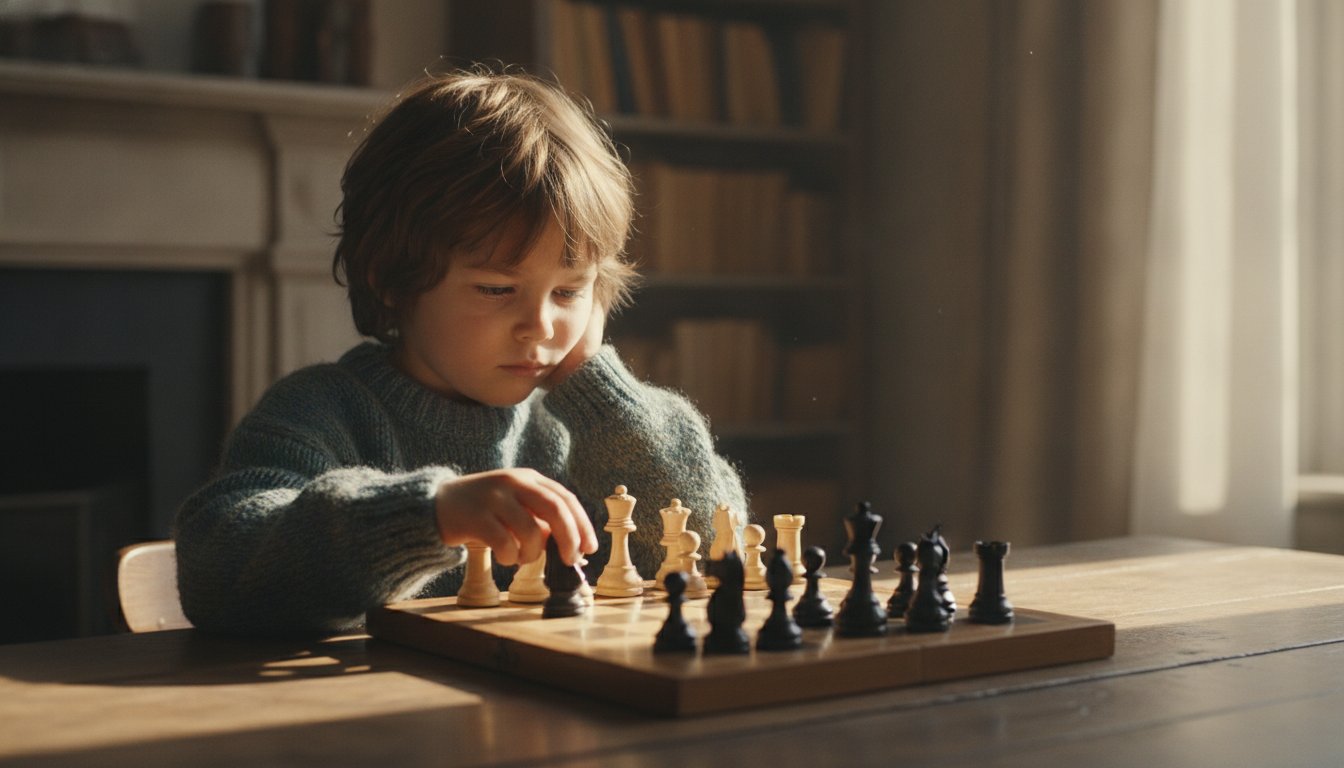
Why Chess Kids Have Sharper Focus — and Brains That Show It
In August 2025, a 10-year-old girl from London sat across a chessboard from a 60-year-old grandmaster — a title held by only a tiny number of the best players in the world. Her name is Bodhana Sivanandan. By the end of the game, she had won.
A 10-year-old British girl made chess history by becoming the youngest female player to ever beat a grandmaster, defeating 60-year-old grandmaster Pete Wells in the final round of the 2025 British Chess Championships in Liverpool. Two months later, she did it again. The "girl wonder" defeated former women's world champion and grandmaster Mariya Muzychuk, and experts called the win a "near-perfect game."
How does a child that young sit still, stay calm, and out-think an adult who has played chess for decades? The answer has a lot to do with something every parent worries about today: focus.
The Attention Problem Every Parent Knows
Look around any classroom, playground, or living room today, and you'll see it — children jumping from one thing to the next. A video, then a game, then another video. Many children today find it hard to sit with one task for more than a few minutes.
Researchers studying young children noticed the same thing. In one study, scientists explained their reason for looking into chess: today, many children are easily distracted by perturbing factors when performing important actions, which leads to poor performance. So they decided to test something simple: could chess help?
They took 29 primary school children, aged 6 to 11, from urban and rural areas, who attended chess courses once a week for half a year. Then they measured "focused attention" — the ability to concentrate on one task without getting pulled away. The children who learned chess showed real improvement in their ability to concentrate.
This is not a one-off finding. It keeps showing up, study after study, country after country.
What the Newest Research Found
In 2025, a researcher named Yuhan Ye ran a detailed study across two kindergartens, comparing children who learned chess with children who didn't. The results were striking. Results from independent samples t-tests revealed significant improvements in attention, memory, logical thinking, patience, self-discipline, mathematics scores, and reading scores among children in the experimental groups compared to the control groups.
Look at that list again: attention and memory are right at the top.
The actual numbers tell a clear story too. Children in the experimental group showed significant improvements in attention, memory and logical thinking skills after receiving chess instruction — their attention scores improved from 60 to 75, while the control group improved only from 60 to 62.
That's not a small difference. Children who learned chess improved their attention scores roughly five times more than children who didn't.
Why Chess Is Such Good "Memory Training"
Chess is a strange kind of game. A child has to remember where every piece is, picture moves before they happen, and hold several possible plans in their head at once — all while an opponent is trying to surprise them.
Scientists have a name for this skill: working memory. It's the mental notepad your brain uses to hold information while you think. Reading, solving math problems, and following multi-step instructions in school all depend on it.
A two-year study tracked schoolchildren who received regular chess training, and researchers explained why chess works so well as memory exercise: while playing chess, children evaluate positions, visualize new positions in their mind, evaluate the pros and cons of each move, and choose moves based on the information stored in their mind. That is working memory, exercised dozens of times in a single game.
A newer study on preschoolers found the same pattern. Comparing 5 and 6 year olds who took chess classes with those who didn't, researchers found that children who participated in chess classes exhibited significantly higher visuospatial working memory scores compared to their non-chess playing counterparts. In simple words: the kids who played chess were better at holding pictures and patterns in their minds. The researchers concluded that chess classes may represent a viable method for enhancing visuospatial working memory in preschool-aged children.
Brain Scans Are Now Showing This Too
Here is where the research gets really interesting. Scientists didn't just test children with pen-and-paper tasks — they looked inside their brains using scans.
One study compared children who were skilled chess players with children who were new to the game. The physical structure of their brains was different. The cortical thickness in parietal regions related to visual spatial abilities was significantly thicker in experts than in novices, and it showed a significant positive correlation with brain regions related to visual spatial working memory.
The brain activity was different too. Children learning chess showed higher baseline spontaneous signal intensity in the dorsolateral superior frontal gyrus, cingulate gyrus, and orbitofrontal cortex — regions tied to attention and self-control. And on memory tests, expert-level children were significantly better than novices in accuracy and reaction time.
In plain language: the parts of the brain used for focusing, remembering, and controlling impulses were more active and more developed in children who played chess regularly.
Back to Bodhana
This brings us back to that 10-year-old in Liverpool. Chess experts who watched her play didn't just praise her bravery — they praised her composure. She sat through a long, tense game against a much older, far more experienced opponent, and she did not lose her concentration.
She picked up the sport during the Covid pandemic when she was five, after one of her dad's friends gifted her a chess set. Five years of regular practice later, her ability to focus for long stretches had become one of her biggest strengths. She isn't the only young player to reach record-breaking milestones recently — but her story is a reminder that the quiet skill behind every strong chess game is the same one every parent wishes for: the ability to sit, concentrate, and think clearly for long periods, something even many adults struggle with.
Of course, very few children will become champions, and that was never the point. The focus, patience, and memory that chess builds are useful for every child, every single day — in homework, in exams, in conversations, in simply listening to a teacher without drifting off.
What This Means for Your Child
You don't need to sign your child up for chess championships to get these benefits. Just regular, consistent practice — even once or twice a week — has been shown to build attention and memory over time.
The research keeps pointing the same way: children who play chess regularly tend to concentrate better, remember more, and stay calmer under pressure than children who don't. In a world that is constantly competing for your child's attention, chess quietly trains them to take it back.
That is exactly why PrimeChess.org built its online chess classes for children aged 6 to 13 — structured, weekly sessions with real coaches, designed not just to teach the rules of chess, but to build the kind of focus and memory that helps children everywhere, on and off the board.
PrimeChess Courses
Keep learning with PrimeChess
If tactics are improving but plans still feel unclear, the Intermediate Course teaches strategic thinking, practical openings, and endgame technique for growing competitors.