Why Some Kids Can Focus for Hours (While Others Can't Sit Still for Five Minutes) — And What Chess Has to Do With It
A brand-new 2025 study on young children found that chess training led to big, measurable jumps in attention and memory — far more than children got without it. Here's what the science says, and how it can help your child too.
- chess
- focus
- attention span
- kids education
- cognitive development
- primechess
- online chess classes
- child development
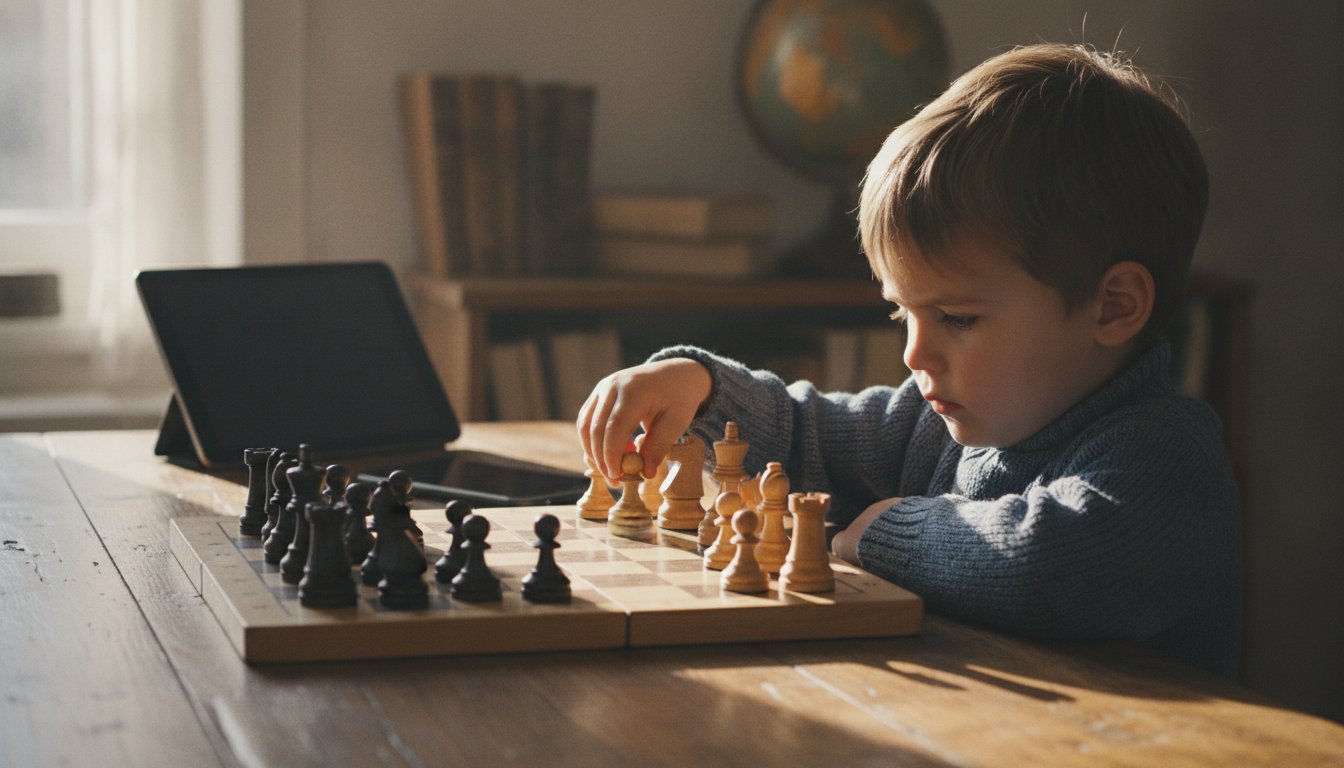
The five-minute problem every parent knows
You've probably seen it. Your child sits down to do homework. Two minutes later, they're staring at the wall, or asking for a snack, or reaching for a tablet. Not because they're lazy — their brain is simply looking for something more exciting to grab its attention.
This is normal. Young brains are wired to notice new things quickly. But focusing on one thing for a long time — like a math problem, a book, or a conversation — is a skill. And like every skill, it has to be trained.
This is exactly where chess quietly does something powerful.
What actually happens in a child's brain during a chess game
Chess looks calm from the outside. Two kids sitting at a board, barely talking. But inside their heads, a lot is happening at once.
A recent study of young children published in the journal Frontiers in Psychology in 2025 explained it well. Researchers noted that chess can effectively exercise young children's attention, memory, logical thinking and problem-solving skills, and when children are in a game of chess, they need to pay full attention to analyzing the situation on the board, remembering the positions of the pieces and the rules of movement, while applying logical thinking to deduce the opponent's intentions and formulate strategies.
In simple words: a chess game forces a child's brain to do four things at once — watch, remember, think ahead, and decide — without looking away. There is no pause button. If a child's mind wanders for ten seconds, they might lose a piece, or the whole game. That instant, honest feedback is something very few children's activities offer.
The study: what the numbers actually showed
The researchers didn't just guess that chess helps focus — they measured it.
Two kindergartens with 200 children each were studied. One group of children received regular chess lessons over several weeks. Another group did not. Before and after, every child took the same standard attention test used by psychologists.
The results were striking. The attention scores of the children in the experimental group improved from 60 to 75, while the control group improved only from 60 to 62. That means the chess-trained children gained more than five times as much on the same attention test as the children who didn't play chess.
This wasn't a small, shaky result either. The statistical strength of the finding was high — results from independent samples t-tests revealed significant improvements in attention, memory, logical thinking, patience, self-discipline, mathematics scores, and reading scores among children in the experimental groups compared to the control groups, with p< 0.001, meaning the chance this happened randomly was less than 1 in 1,000.
The researchers also measured how big the effect was, not just whether it was "real." For attention specifically, they reported a strong effect size, which in plain language means the improvement wasn't tiny or borderline — it was large enough to matter in real life.
Why chess, and not just any game?
A fair question: couldn't any board game train focus? Not quite as well.
Most children's games move fast, involve luck (dice, cards), or let a child "check out" for a turn or two without consequence. Chess doesn't work that way. Every single move can change the whole game. There's no dice to blame, no shuffled deck to hide behind — just the child's own attention and thinking.
This is why researchers describe chess as a "complex and challenging thinking activity" that provides rich cognitive stimulation for young children, requiring them to engage in logical reasoning, spatial perception and strategic planning. The brain gets no shortcuts. It has to stay switched on.
It's not just about the chessboard
Here's the part that matters most to parents: this kind of focus doesn't stay locked inside the game. A child who learns to sit and concentrate for 20, 30, then 45 minutes over a chessboard is quietly practicing the exact same mental muscle they'll need for a school lesson, a reading assignment, or a test.
The same 2025 study found gains that went beyond just attention — children also improved in memory and logical thinking, and their math and reading scores rose significantly more than children who did not receive chess instruction. Better focus seems to open the door to better learning everywhere else, too.
A skill that grows with practice, not age
One more encouraging thing: this isn't about whether your child is "naturally" a focused kid or not. Attention, like a muscle, responds to training. The study's authors recommended that parental involvement and home practice can further enhance the positive effects of chess instruction — meaning consistent practice at home, even for a short time each week, adds up.
This matters especially for kids aged 6 to 13, whose brains are still very actively building the wiring for attention and self-control. The earlier this "focus muscle" gets exercised, the more naturally it becomes part of how a child thinks — at school, at home, and later in life.
Give your child's focus a real workout
You don't need a chess champion in the family to see these benefits. You just need a child willing to sit down, look at 64 squares, and think for a few minutes without a screen buzzing in the background.
At PrimeChess.org, our online classes for kids aged 6 to 13 are built around exactly this: short, structured lessons that gently stretch a child's attention span game after game, with real coaches guiding them the whole way — not an app they play alone.
If you've ever wished your child could focus just a little longer, a little better, chess might be the simplest answer you haven't tried yet.
PrimeChess Courses
Keep learning with PrimeChess
Stuck at chess and not seeing progress? The Beginner Course helps players build reliable tactics, opening habits, and endgame confidence so rating plateaus become easier to break.