Why Chess Kids Make Friends Faster — and Feel Better About Themselves
New research shows chess does more than train the brain — it helps children feel calmer, braver, and more connected to the people around them. Here's what scientists found, and the true story of eight kids from Harlem who proved it.
- chess
- kids
- confidence
- social skills
- emotional health
- parenting
- child development
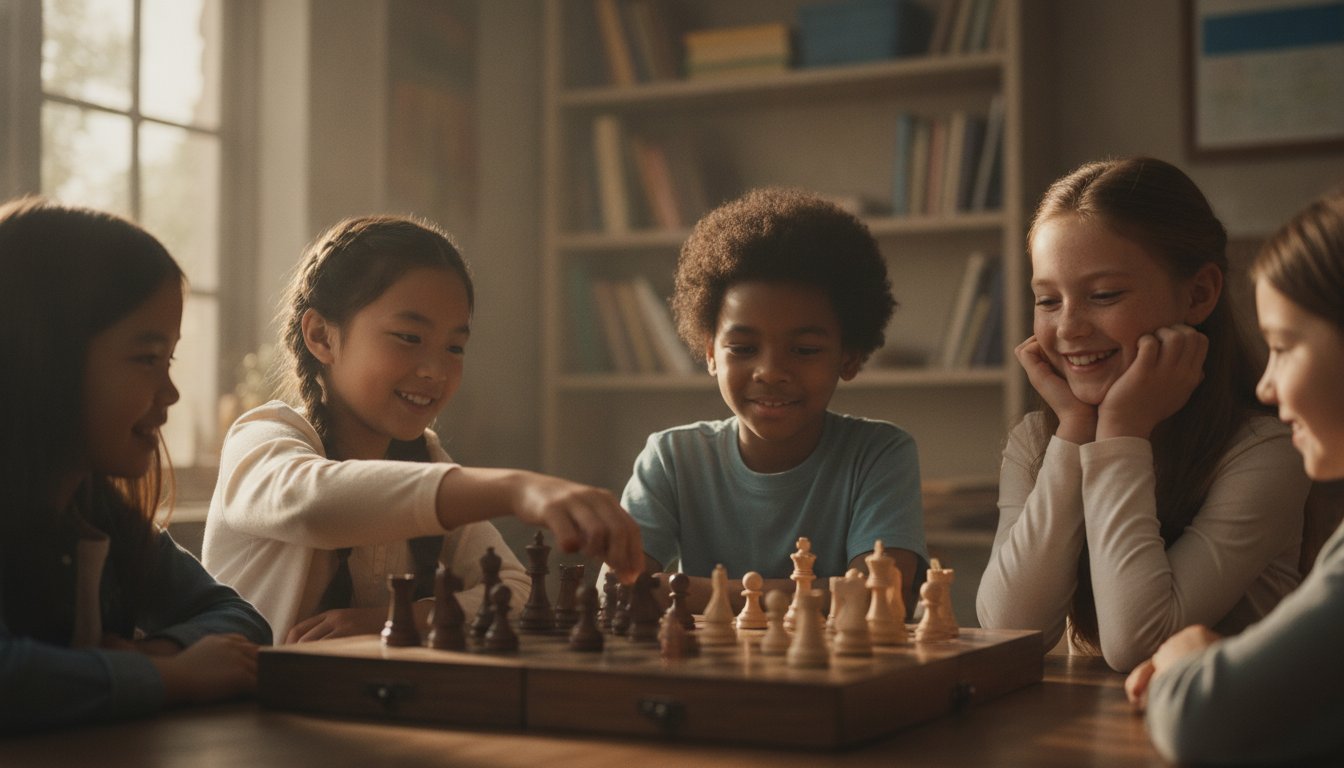
Most parents think chess is a game for "smart kids." Quiet kids. Kids who like puzzles.
But new research is showing something different. Chess may be one of the best ways to help any child feel more confident, make more friends, and feel calmer inside. Even kids who are shy. Even kids who are struggling.
Let's look at what the science says — and a true story that proves it better than any study ever could.
A Game That Builds Confidence, One Move at a Time
In chess, nothing is given to you. Every good move you make, you earned yourself. There is no luck, no teacher grading on a curve. Just you, the board, and your own growing skill.
A 2025 study published in Frontiers in Psychology looked at young children learning chess in kindergarten classrooms. The researchers found something striking: chess players showed significant improvements in teacher-rated social adjustment, peaceful attitudes, and understanding toward others compared to children who played team sports over the same period.
That's an important detail. The comparison wasn't against kids doing nothing — it was against kids playing team sports, which most people already consider great for social growth. Chess still came out ahead.
Kids Are Making Friends Over the Chessboard
Many parents worry that chess might make their child more isolated, not less. The research says the opposite.
In the same study, 84.6% of parents reported their children successfully made new friends as a direct result of playing chess, dismantling the cultural stereotype that chess is socially isolating.
Parents also noticed real emotional changes at home. 41.6% of parents identified impatience as a negative trait that chess directly helped their children overcome, and 25.6% reported reduced fear of expressing oneself.
Think about that last one for a moment. A quarter of parents said their child became less afraid to speak up — simply from playing a board game regularly. That's not a small thing for a shy child.
The study also found measurable gains in teamwork and talking skills. Parents rated chess highly for developing relationship skills, spirit of cooperation, and communication skills development. And even very young players benefited — kindergarten-aged chess players showed statistically significant improvements in patience and self-discipline compared to non-chess control groups.
The Story of the "Raging Rooks"
Numbers are convincing. But sometimes a true story says it best.
In 1991, in Harlem, New York, eight teenagers from a tough neighborhood started arriving at their school an hour early every morning — just to play chess. On that cold 1991 morning, there were eight of them to converge at high school, eight kids of 13 or 14 who have torn themselves out of bed to arrive an hour before the rest. They called themselves the "Raging Rooks."
These were not kids from wealthy chess academies. Real life was elsewhere, in a neighborhood ravaged by poverty and drugs. Chess was something nobody expected them to be good at.
A few months later, they won the United States high school chess championship — beating teams from private schools that charged more in tuition than these kids' parents earned in a year. Their story later inspired a Disney movie and a wave of school chess programs across New York.
Almost thirty years on, their influence is still felt. The kids of Harlem continue to inspire thousands of New York kids from minorities, who today represent 40% of the players in the schools of the city, compared with 10% at the time.
What changed these kids wasn't just their rating points. It was what chess gave them: a place to belong, a reason to feel proud, and proof that they could win at something the whole world thought wasn't "for them."
Chess Can Also Calm the Mind
It's not only confidence and friendships. New research in 2026 looked at something even deeper — emotional well-being.
Scientists studied teenagers receiving mental health treatment, and added weekly chess sessions for some of them alongside their regular therapy. The results were encouraging. Chess-based training was associated with improved working memory efficiency and psychological well-being, supporting its potential as a feasible, engaging, and low-risk addition to standard therapy.
Of course, your child probably doesn't need therapy. But this tells us something important: chess isn't just good for grades or test scores. It can genuinely help a child's inner emotional world feel steadier.
Why Does a Simple Board Game Do All This?
Here's the simple explanation. In chess:
- Every win is earned through your own thinking, not luck — which builds real self-belief.
- You sit across from another child, look them in the eye, shake hands, and respect their effort — which builds social skill.
- You face setbacks constantly but keep coming back — which builds calm and patience.
- You belong to a community of players, clubs, and tournaments — which builds friendship.
None of this requires a child to be a "genius." It just requires practice, a good teacher, and a little encouragement.
Give Your Child This Head Start
The Harlem kids didn't become confident, connected, and calm by accident. It happened because one teacher gave them a chessboard and a little bit of belief.
Your child doesn't need to grow up in a tough neighborhood to get these same benefits — just the right guidance, starting early.
At PrimeChess.org, our online classes are designed for children aged 6 to 13, taught by patient instructors who care about more than just winning — they care about building confident, well-rounded kids, one move at a time.
PrimeChess Courses
Keep learning with PrimeChess
Preparing for serious tournament games? The Advanced Course gives ambitious players deeper positional training, calculation work, and expert analysis for tougher competition.